

If you do not see the audio player on this post, click HERE.
Visit Partisan Radio at PODBEAN to DOWNLOAD this and previous episodes!
 AmRRON CW Net 2nd Saturday Each Month
RESOURCE LINKS
http://ac6v.com/morseaids.htm
Morse code is still worth learning – but why?
http://www.g4fon.net/CW%20Trainer.htm
AmRRON CW Practice Net
Internet banned in J&K for two days from tomorrow
Sparks-31 in Western Washington
FireChat Information
Worked here. Time to brush off the old CW app.
Is there a reason Partisan Radio isn’t on iTunes like Radio Free Redoubt is>>>???? It would make it so much nicer and easier for those of us in the Apple iTunes World to just get all our favorite podcast from one source…. instead I have to come to a pod beam website and download a file. Its not that big a deal but its nice when iTunes will do it all for me automatically and sync with my phone and iPad and I don’t have to do anything but hit play. It saves me time looking here anyway.
Great topic. Ive been attempting to learn cw for a while. Im extremely slow but apps you mentioned are helpful for sure. You mentioned you would produce more on this topic; could i make a request? I am at the point of looking at equipment. Lots of brands and different kinds of keyers (iambic vs paddle vs bug vs straight key). Some are really expensive. And does it plug right into my ICOM or do I have to purchase additional equipment? Some code is sent so fast I can’t even begin to copy so is there any value to owning a morse reader/keyer unit? (e.g. MFJ-464) Thank you JJ for this topic, any resources you have are greatly appreciated.
TM66
I recommend starting off like most of us did… pick up an old keyer. They can be had very inexpensively. My first keyer was a WWII-era J-47, and I love it. Not as smooth as a paddle, such as my American Morse Company ‘Mini B’. It really comes down to personal preference as far as Iambic keyers, paddles, etc. Yes, the 3.5mm jack on a keyer will plug right into the back of the Icom (assuming you have a modern HF rig). For the rest, I’ll have to address it on Partisan Radio. Too much to go into here. Just have fun, and be persistent!
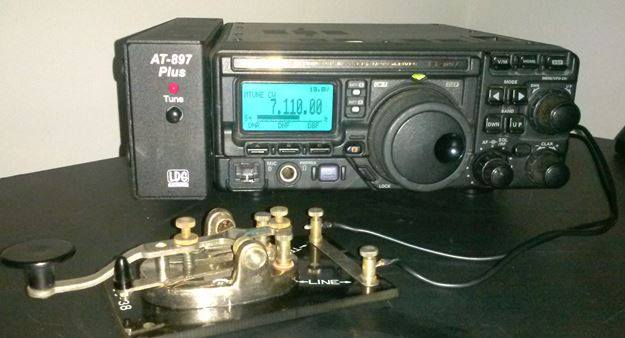
Where did that picture come from? You’ll never send Morse Code the way that J-38 is wired. It really would be continuous wave HI HI.
dah-di-di-di-dah
On a serious note, thanks to JJS for spotlighting this fun and empowering mode (CW). It’s an awesome feeling to communicate using CW. Also, never, never, NEVER attempt to learn CW by eye (alphabet tables of dots and dashes). CW should only be learned by ear!
FB ES HPE CU on cw nets DE Hotel-04 dit dit
That photo came from Polly-01’s photo studio. I wanted an original image (no copyright). I just watched a short little youtube video for J-38 and see what you mean. I have not started CW yet, and looking forward to learning! Good eye and thanks for the tips!
For some interesting history check out http://www.radiomarine.org
Be sure to read some of the story’s at the Incredible Radio Tales
tab. The “Night of Nights” event is fun also. Lots of good YouTube videos about the station and special event.
For someone just starting out in CW, what is the best, and fastest way to learn?
What equipment is necessary… I have been looking for a list lately but haven’t found one yet.
Great article. I have been a radiotelegraphist for over 45-years. Was still using it in 2006, especially for engineering RATT/RTTY and CRATT/CRTTY ACP-126 links (and nets) using ACP-124 RTG , but now only use it “recreation activity” (hobby).
The benefits mentioned in the broadcast are correct, esoecially IRT marginal communications (when digital hf modes fail), and to mask prominent ideosyncratic identifiers such as accents.
My preferred teaching method, however, is Fred Keller’s Code-Voice method. I have used it to train well over a few hundred operators to the basic level (5 wpm), of which many progressed up to 20 wpm plain alpha-text / 16 gpm figures. The aim, of course, was to have field operators (ACP-124) at a net-speed of 15 wpm plain alpha-text / 12 gpm figures, which is about as fast as I can scribe with pencil on paper. Also, the character speed was 20 wpm. //// Orderwire and rear-link locomd-to-hicomd communications were usually at higher speeds (i.e. about 25 wpm plain alpha-text / 20 gpm figures) , and dedicated receive operators used typewriters/keyboards. The character speed was usually 25 wpm, and sometimes 30 wpm. At these speeds the transmit operators used semi-automatic keys (i.e. Vibroplex Bugs, which we trained to use “off hand” – not the master hand) as they were more efficient and effective for passing bulk formal (both allied, and civil) traffic, BUT we also maintained RATT/CRATT (RTTY/CRTTY) links, often anchored into the National systems, so would only use CW radiotelegraphy when the RATT/CRATT went down.